Dhvani
Real-Time Audio Analysis & Speech Emotion Recognition Platform
Project Overview
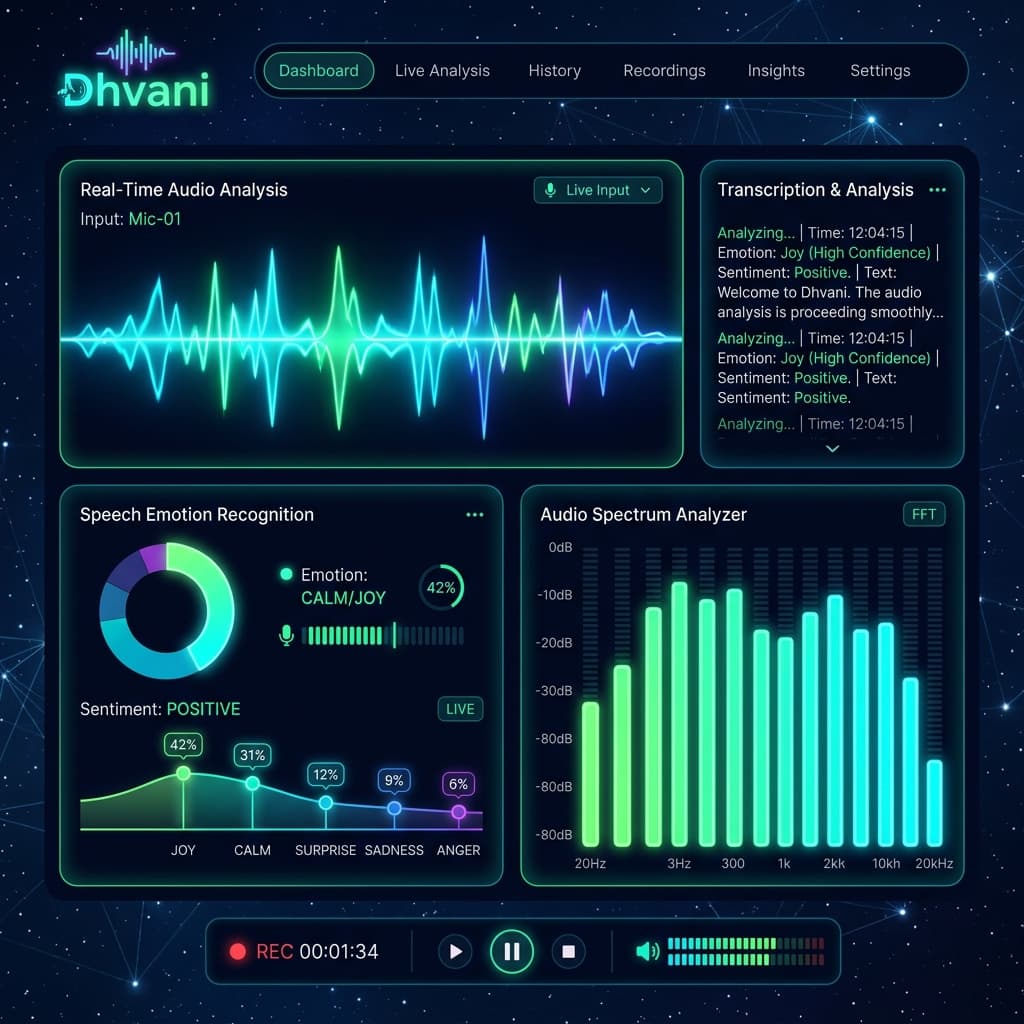
Dhvani is a high-performance web audio processing application that performs real-time acoustic signal spectrum visualization, speech transcription, and sentiment classification.
The Problem & Motivation
Traditional speech analysis required heavy desktop software, lacking web-accessible real-time FFT spectrum visualizations and instant sentiment feedback.
System Architecture Diagram
Key Engineering Features
60 FPS Spectrum Analyzer
Low-latency Web Audio API FFT visualizer.
Renders frequency spectrum bars and waveform oscillograms smoothly without UI thread lag.
Speech Emotion Classification
Machine learning acoustic tone detector.
Classifies vocal emotions (Joy, Calm, Surprise, Anger) with high precision confidence metrics.
Full Technology Stack
Technical Challenges & Engineering Solutions
Canvas 60 FPS Frame Rate Stability
Challenge: Continuous Web Audio API buffer sampling was triggering excessive React re-renders.
Solution: Decoupled canvas drawing loop into requestAnimationFrame ref handles, bypassing React component state updates entirely.
Measurable Results & Outcomes
What I Learned
- Deep understanding of Web Audio API, Fast Fourier Transforms (FFT), and raw binary sound buffers.
- Gained hands-on experience deploying PyTorch models inside containerized Python microservices.